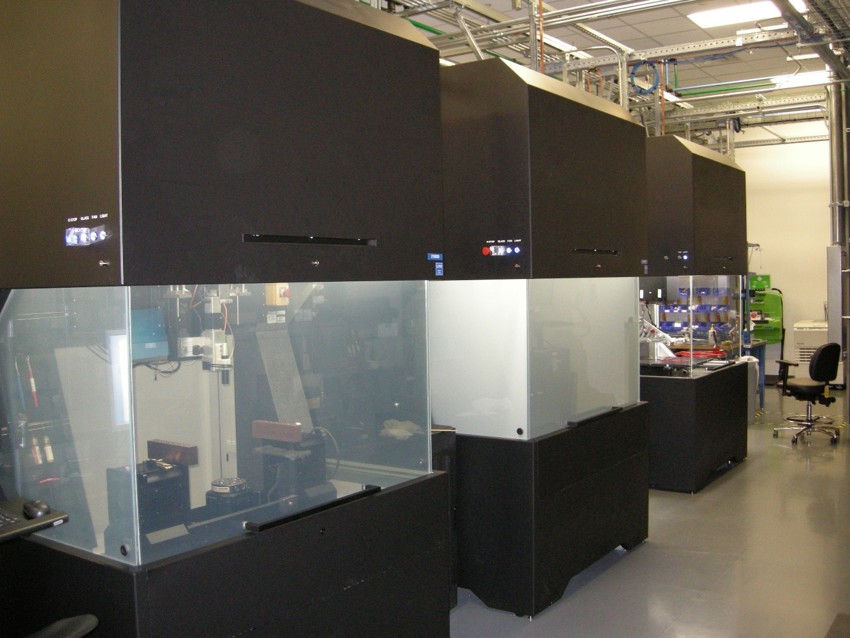

Layer by layer: How additive manufacturing is transforming production at KCNSC
KCNSC’s additive manufacturing accelerates how parts move from concept to factory floor, strengthening production and supporting the nation’s nuclear deterrent.

In national security work, agility is not optional. At the Kansas City National Security Campus (KCNSC) additive manufacturing turns digital designs into physical parts in hours or days, helping teams move quickly when the mission requires it.
If traditional manufacturing is like sculpting a statue by chiseling away marble from a solid block, additive manufacturing (AM) is more like building a brick house: placing materials precisely, layer by layer, directly from a digital blueprint.
What started decades ago as basic 3D printing for quick plastic prototypes has evolved into a production power tool for KCNSC. Today, AM is not only a faster way to make parts — it’s rewriting the rules of design, speed and flexibility across nuclear security programs.
Flipping traditional design on its head
For generations, industrial manufacturing designed parts around the physical limitations of drills, mills and lathes. AM flips that paradigm by constructing parts from the bottom up.
By placing material only where needed, engineers can create complex geometries, internal features and lightweight structures unlike parts machined through conventional methods. It allows design agency partners and internal KCNSC engineering teams to design purely for performance rather than manufacturing constraints.
KCNSC employs a wide spectrum of AM technologies, including:
· Direct ink write (DIW): A printing technique that extrudes liquid, gel or paste-like inks through a fine nozzle to build three-dimensional structures layer by layer.
· Powder bed fusion: A method that uses a heat source, like a laser or an electron beam, to selectively melt or fuse loose powder particles together layer by layer
· Stereolithography (SLA): A technology that turns liquid photopolymer resin into a solid three-dimensional object using ultraviolet lasers to cure the material.
· Emerging composite AM: An advanced technology that builds strong, lightweight parts by combining base materials like metal with reinforcing fibers, nanoparticles or ceramics.
KCNSC uses AM every day. Beyond design flexibility, AM serves as a rapid-response capability that can help ensure we meet critical national security work.
Quick-turn printed fixtures and hardware have repeatedly enabled faster prototyping and engineering agility.
In one case, engineers scanned a physical part, generated a digital 3D model and printed a functional replacement prototype on the spot.
According to one KCNSC manufacturing manager, “The seamless transition from scanning to printing feels futuristic. There’s something remarkable about closing the door on an AM printer and later opening it to find a finished part — almost as if it materialized out of thin air.”
While AM offers unprecedented agility in manufacturing, it doesn’t replace standard processes — it complements them.
Traditional subtractive and molding processes remain vital for high-volume, standard geometries, while additive technology accelerates early learning cycles, custom tooling and specialized production runs.
One of KCNSC’s distinctive strengths is its wide range of manufacturing technologies. As materials advance and printing techniques become even more precise, KCNSC technology development and process engineering teams continue to evaluate new processes to support national security needs.
By bridging traditional techniques with cutting-edge innovations, KCNSC ensures it stays ahead of evolving mission demands.