

Tortellini the Turtle gets help swimming with 3D-printed technology made at KCNSC
KCNSC assists turtle at Kansas City Zoo & Aquarium

A long-time Friend of the Zoo member, Holly Weber, Principal R&D Scientist for the Kansas City National Security Campus (KCNSC), regularly visits the Kansas City Zoo & Aquarium. During one of her visits, she noticed a sea turtle that was swimming awkwardly, with the back part of her shell elevated above her head. Holly immediately became curious.
The turtle, known as Tortellini, has a condition called Positive Buoyance Syndrome — “bubble butt” damage to the back of her shell and spine likely due to being struck by a boat propeller. This condition causes issues in her GI tract, where trapped gas bubbles cause buoyancy issues. While on winter break in 2024, Weber ran across an article by NPR about a sea turtle at the Mystic Aquarium in Connecticut that was able to swim normally with the help of a 3D-printed harness.
“Our daughter is a zookeeper, and from her journey and our journey with her, animals are important to our family,” said Weber. “I thought this project was interesting because a harness had been created before, so we could do it, too.”
Every day, nearly 7,000 talented employees come to work at the KCNSC to create innovative solutions to solve national security challenges. KCNSC has leading-edge technology experts in engineering, science and manufacturing, so it wasn’t difficult finding people with the right skill sets to help Tortellini. Weber contacted her colleague at KCNSC, Senior Fellow and Chief Scientist Dan Bowen, and together they worked to get the project off the ground. After gaining approval from KCNSC’s Senior Leadership Team and securing non-government funding, Weber reached out to the staff at the KCZoo to ask if they wanted to partner on this project to create a weighted harness to help Tortellini swim better.
“This is too cool to pass up,” said Bowen. “My dad is a biologist. I grew up around animals, and I thought that not only was this something KCNSC could do, but it also would be really valuable to the community. And the idea of helping this cute turtle swim better just melted my heart.”
Tortellini’s story
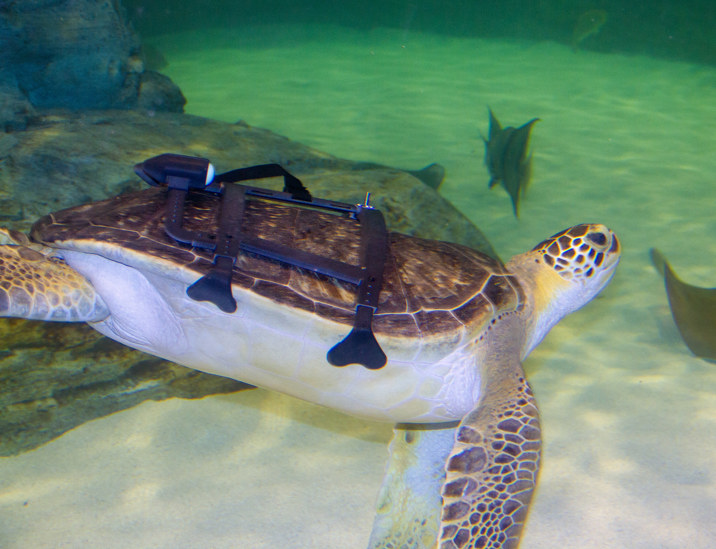 Tortellini is a green sea turtle, which is the largest hard-shelled sea turtle species in the world. Turtles like her can grow up to 4 feet long, weigh more than 300 pounds, and live to be 70 years old.
Tortellini arrived at the Kansas City Zoo & Aquarium on Aug. 6, 2023, after members of the KC care team drove to the Clearwater Marine Aquarium to pick her up from the rehab facility, where she had been living following her injury. Tamara Arndt, Animal Care Team Lead at the KCZoo, said Tortellini was an immediate fit.
“When I saw Tortellini, it was love at first sight,” said Arndt. “I participated in sea turtle rehab for five years at another facility before coming to Kansas City. I cared for and loved many turtles during that time, but none immediately captured my heart the way that Tortellini did.”
With her injury, Tortellini lives a mostly normal life, but sometimes struggles with her buoyancy. When she sleeps, Tortellini has to wedge herself under a rock ledge so that she can stay submerged in the water. This injury would prohibit her survival in the wild.
The zoo had tried weighted harnesses on Tortellini before. One attempt was a weighted neoprene pouch that allowed her to swim normally, but the pouch bothered Tortellini, and she kept scratching it off. They also tried unsuccessfully to adhere weights directly to Tortellini’s shell.
Additive Manufacturing
Back at KCNSC, Weber reached out to Neiko Levenhagen, Lead R&D Scientist, and polymer additive manufacturing (AM) expert for insight. Neiko assembled a polymer AM technical team, including Senior Mechanical Engineer Peter Roth, to design and manufacture Tortellini’s harness. The first step in the process was meeting with the zoo to find out what might work for the harness design. The KCNSC and KCZoo teams contacted the Mystic Aquarium in Connecticut where Charlotte the sea turtle had a 3D- printed harness and asked questions about the design, and what improvements could be made based on their experiences.
There were many considerations to creating a harness for Tortellini, including her injury site, the aquatic nature and other elements of her habitat, which included other animals. Because a sea turtle shell is part of the reptile and grows as the turtle does, Tortellini now has an indentation at her injury site that sheds more than the rest of her shell. She likes that spot to be scratched, which was an important factor in creating a harness — giving her the ability to scratch her shell without getting caught on any part of the underwater exhibit was a high priority. Tortellini’s care team also wanted the harness to be one piece that could be taken on and off easily without touching her injury site and for it to be adjustable so it can expand as Tortellini grows. Another challenge was creating a harness for a creature that lives in salt water, something the KCNSC team had never done before. They looked at materials that would be durable in salt water, including nylon and marine-grade epoxy.
The next step was to create a 3D-printed scale model of Tortellini’s shell so that an accurate model could be manufactured.
“This was a new experience for me — I’ve never 3D scanned something living, let alone a sea turtle,” said Senior Mechanical Engineer Peter Roth, who is part of the KCNSC engineering team for the Tortellini project “We ended up using a 3D-scanning software on our phones, so we wouldn’t have to apply anything to Tortellini. The underside of her shell is soft tissue, and we wanted to keep the stress off there.”
The 3D scan of the shell was then put into the Computer-Aided Design (CAD) program, which was turned into a workable 3D model. The team held several brainstorming sessions to figure out what they wanted the harness to look like. From there, they determined the general shape and features in CAD. Roth used the CAD program to input the 3D-printed shell, then carved a giant block of Tortellini’s profile digitally in the CAD system until he had something that resembled a harness. He then refined it until it became a model the team could use, which took several iterations.
To create the harness using 3D-printing, the team used a technique called multi jet fusion, where powder gets loaded into the 3D-printing machine before the design is printed one layer at a time. The process is similar to an ink-jet printer that is depositing little droplets into the shape of the part. Once those droplets are deposited, the machine heats up the material and fuses it together.
“I think the most interesting part is that we are really good at rapid prototyping but these applications aren’t used on living things,” said Levenhagen. “We had to switch the mindset to ergonomics and comfort for a living creature. You’re dealing with a living thing instead of plastic.”
As the team built and printed the first prototype of the harness, they learned what worked about the design and more important, what did not. Zoo staff visited KCNSC to look at the first prototype harness and made suggestions.
“The first model was blocky and bulky to get the concept of the harness,” said Roth. “We wanted to reduce the size and keep it closer to her profile. The harness’s feet weren’t well defined and were blocky.”
The challenge with the harness was getting a snug fit that contoured around Tortellini without creating hot spots on her shell. Padding was added to the harness to make it more comfortable for Tortellini and to prevent the harness from slipping off her.
After input from the zoo, KCNSC created a second prototype, and it was time for Tortellini to test the harness.
The field test
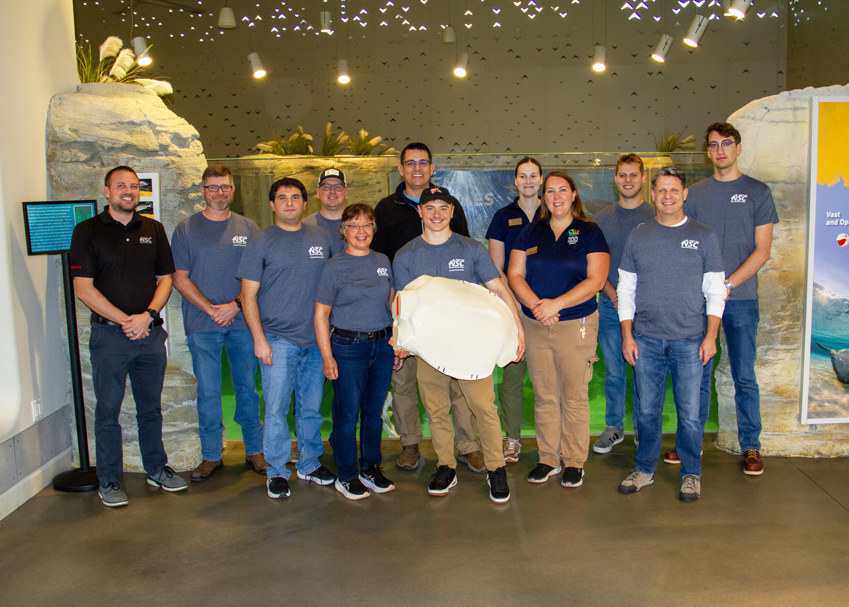 On Dec. 5, 2025, the KCNSC team took the harness to the zoo for the official test. The team demonstrated how to use the harness with the 3D-printed model of Tortellini’s shell. After some practice, Tortellini’s care team was ready to give it a try.
Levenhagen -- with help from the zoo staff -- quickly put the harness on Tortellini, and soon the sea turtle was swimming with the harness in her exhibit. The zoo staff observed that Tortellini hardly noticed the harness. After about 15 minutes, she was sleeping comfortably at the bottom of the enclosure, which seems to indicate that she is comfortable in the harness.
The KCNSC team noticed that some adjustments still needed to be made to the harness to fully improve Tortellini’s buoyancy, and they are now working on it to ensure the harness works long term for Tortellini.
Thrilled that the harness helped Tortellini swim comfortably with improved buoyancy, the KCNSC team began thinking about other sea turtles with the same condition and how harnesses like Tortellini’s might be able to help other turtles, too.
With this unique project, the KCNSC team hopes their work will inspire future engineers.
Levenhagen noted the impact of this project is even farther reaching due to the number of people who can see how it has helped Tortellini. “People can see Tortellini in the aquarium with her harness and then see the 3D model of her shell up close. For kids learning that it is 3D printed is really exciting. As a kid, my mind would have been blown; I would have wanted to know so much about the engineering. Now I think it may spur a bunch of future engineers,” said Neiko.
Tortellini’s 3D-printed shell and a prototype of her harness will be gifted to the zoo, so that docents can teach visitors about the harness and let them see it up close.
Weber said this project is something that she hopes will inspire the next generation. “The 3D-printed model will spur a lot of curiosity with people,” she said. “Our engineering team did this and put this together, and I hope it will pique interest in STEM. If I were a kid, I’d be interested in it.”

